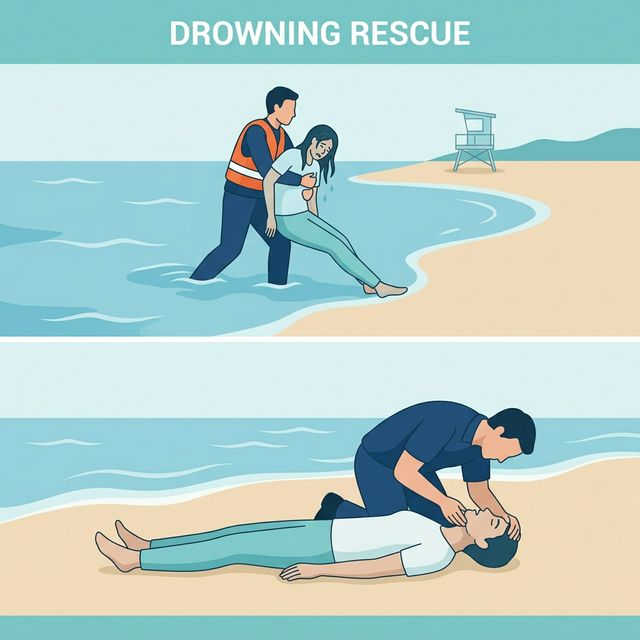
Drowning — Water Rescue & CPR
How to safely rescue and resuscitate a drowning victim.
How to safely rescue and resuscitate a drowning victim.
Drowning can cause death in under 5 minutes. Never enter deep water unless you are a trained rescuer. Use a reaching or throwing rescue method first. Brain damage begins after just 4 minutes without oxygen.
Call 911/112 immediately. Shout for a lifeguard. Do NOT jump in unless you are trained — panicking drowning victims can pull rescuers under.
Extend a pole, rope, towel, or branch to the person. Throw a life ring, cooler, or any flotation device. Only enter water as a last resort and with a flotation aid.
Once the person is out of the water, lay them on their back on a flat surface. Check for responsiveness — tap and shout.
Look, listen, and feel for breathing for no more than 10 seconds. If they are not breathing or only gasping, begin CPR immediately.
Give 5 initial rescue breaths first (drowning victims need air urgently), then continue with standard CPR: 30 chest compressions followed by 2 breaths. Continue until help arrives.
If the person starts breathing, place them in the recovery position (on their side) to allow water to drain from their mouth. Keep them warm.